
Governing Bodies
FLASHBACK: FIFA FINES NIGERIA FOR WITHDRAWAL FROM WORLD CUP

BY KUNLE SOLAJA.
On this date, 20 July 1965, the World football governing body, FIFA slammed a 5,000 Swiss Francs on Nigeria for a sudden withdrawal from the 1966 World Cup which finals took place in England.
In the preliminary competition, Nigeria along with 14 other African teams entered. At the time, both Africa and Asia had one joint slot at the World Cup. The winner of the continental series in Africa was to face that of Asia to be able to qualify for the final tournament.
While Africa had 15 entries, Asia had just two who were to contest with Australia from Oceania and South Africa, which opted for the zone on political ground.
FIFA reasoned that the half allocation to both Asia and Africa was occasioned by the fact that the two continents did not have teams that qualified for Sweden 1958 and Chile 1962.

The 15 teams in Africa were divided into six groups of either two or three teams.
Nigeria was grouped with Libya and United Arab Republic (Egypt/Syria) in Group 6.
The six group winners were to move into round two with the following pairings: Group 1 to face Group 5 while Group 2 winners were to face that of Group 4.
The Nigeria’s group winner was to face the eventual champion of Group 3, which had Algeria, Liberia and Tunisia.
But the matches did not hold in Africa following a mass boycott. First to withdraw on 17 August 1964 were Morocco and Ethiopia.
Then on 21 September 1964, the quartet of Guinea, Ghana, Senegal and Tunisia joined. On 8 October 1964, South Africa, based on protest to FIFA by Egypt (then UAR), was also thrown out.
It was on that day that Nigeria and all the remaining African countries announced their withdrawal from participating in the World Cup 1966 qualifiers.
Also, Syria, which had pulled out of an earlier political union of UAR withdrew from Europe Group 9 where it was to compete.
Asia’s four teams had their fair share of controversy too.
The league-styled games were to be played on a neutral ground, Japan.
South Africa was banned by FIFA on account of apartheid policy.
That left three teams to contest. South Korea also withdrew when the tournament was moved from Japan to Cambodia.
On account of North Korea not having diplomatic relationship with most Asian countries, it was difficult finding a suitable country to host the tournament until North Korean leader, Kim II-Sung convinced his Cambodian ally to host the matches.
That left only Australia and North Korea to play in duels easily won by North Korea.
For the final round, North Korea were to play the three final group winners from Africa on home and away basis with the winning side of the quartet qualifying for England ’66.
Because of the withdrawal of the African teams, North Korea qualified automatically.
FIFA, in its reaction to the boycotts, fined the boycotting countries including Nigeria.
In the letter sent to Nigeria and dated 20 July 1965, FIFA stated that Nigeria breached the competition’s regulations by withdrawing after the preliminary competition had started.
The NFA was given a deadline of 31 December 1965 to pay the fine.

FIFA’s independent Ethics Committee has banned former Guyana Football Federation (GFF) General Secretary Ian Alves from all football-related activities for five years after finding he sexually harassed female staff members.
FIFA also fined Alves 20,000 Swiss francs ($22,000) after determining that he had breached provisions of the FIFA Code of Ethics relating to the protection of physical and mental integrity, abuse of position and general duties.
“FIFA has a strict stance against all forms of abuse in football,” the organisation said on Monday.
The decision followed a review of written statements from the victims, documents provided by the GFF, submissions from Alves, and other evidence gathered during the investigation.
Alves stepped down from his position in 2024.
The ban came into force on Monday, when the terms of the decision were notified to Alves, and the full grounds for the ruling will be communicated within 60 days in accordance with the Code of Ethics, FIFA added.
The GFF did not immediately respond to a Reuters request for comment. Alves could not immediately be reached for comment.
Join the Sports Village Square channel on WhatsApp: https://whatsapp.com/channel/0029Vaz7mEIGk1FxU8YIXb0H
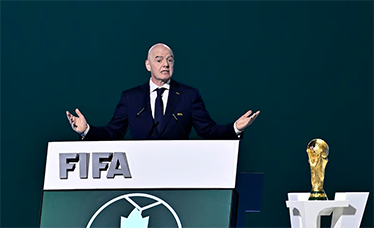
FIFA President Gianni Infantino said on Thursday that he planned to seek re-election for a fourth term in a bid to continue to lead the governing body of world soccer.
Infantino confirmed he would run for the 2027–2031 term in the closing moments of the FIFA Congress in Vancouver, which comes less than two months before the start of the World Cup.
The election will be held on March 18 in Morocco, which is set to co-host the 2030 World Cup.
Infantino said he was “honoured and humbled” to have the chance to run for a fourth term.
The Italian-Swiss took office in 2016, replacing Sepp Blatter, and was re-elected unopposed in 2019 and 2023.
Infantino has pushed for the expansion of FIFA competitions during his tenure, with this year’s World Cup in North America the first to feature 48 teams, while the women’s tournament in 2023 has been expanded to 32 teams.
Infantino’s tenure has also drawn some criticism over issues such as high World Cup ticket prices and the decision to award the inaugural FIFA Peace Prize to U.S. President Donald Trump at the World Cup draw in December.
Earlier this month, the council of South American football’s governing body (CONMEBOL) said in a statement it would unanimously support the 56-year-old if he decided to seek another term.
-Reuters
Join the Sports Village Square channel on WhatsApp: https://whatsapp.com/channel/0029Vaz7mEIGk1FxU8YIXb0H
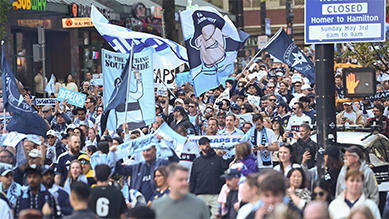
The supporters of Vancouver Whitecaps, a professional football (soccer) club in Canada, have staged a protest outside the FIFA Congress on Thursday, voicing fears that the Major League Soccer club could be relocated as uncertainty deepens over its ownership and long-term future.
The club is one of Canada’s most historic football institutions and has long been a central part of Vancouver’s sporting identity.
Around 100 fans gathered as delegates arrived for the annual FIFA meeting in Vancouver, chanting, singing and waving club flags in a show of solidarity. The demonstration comes just days after Vancouver Whitecaps FC revealed difficulties in securing a buyer willing to keep the club in the city.
The Whitecaps disclosed earlier this week that “stadium economics, venue access and revenue limitations” have complicated efforts to sell the club, despite a 16-month search for new ownership.
Season ticket holder Derek Hawksworth said supporters felt compelled to act amid growing fears of relocation.
“I wanted to come down given the threat of the team possibly moving,” he said. “It’s a rich history with the Whitecaps in North America… we want Vancouver to stay and not relocate. The history is here, and we want to continue with that history moving forward.”
The Vancouver Whitecaps are a professional football (soccer) club based in Vancouver, Canada. They currently compete in Major League Soccer (MLS), the top-tier league in the United States and Canada.
Concerns were heightened by reports that cities such as Las Vegas and Phoenix are leading contenders should the club relocate.
Vancouver Mayor Ken Sim has urged intervention, calling on the provincial government — which owns BC Place — to negotiate a “bridge deal” that would allow the team to remain while plans for a new stadium are explored. The club’s current lease at BC Place expires at the end of the year.
Despite the off-field uncertainty, the Whitecaps have been one of the standout teams this MLS season. They currently sit second in the Western Conference with 24 points from nine matches, just three points behind the San Jose Earthquakes.
For supporters, however, performances on the pitch offer little comfort as the future of their club hangs in the balance — a situation they hope global football leaders gathering in Vancouver will not ignore.
Join the Sports Village Square channel on WhatsApp: https://whatsapp.com/channel/0029Vaz7mEIGk1FxU8YIXb0H


Shooting Stars, Ikorodu City, in Winner-Takes-All Quest for Confederation Cup ticket

Rangers, Rivers United Seal CAF Champions League Tickets

Barcelona seal 29th LaLiga title with 2-0 Clasico win over Real Madrid
Breaking! Uzoho suspended from Super Eagles’ next match with Sierra Leone
No longer Super League as CAF changes name of its new clubs competition
NIGERIAN FOOTBALL CHIEF EXECUTIVE, SANUSI CHARGES NIGERIAN COACHES TO BE UPRIGHT, DILIGENT
-

 Boxing1 week ago
Usyk backs Joshua to beat Fury ahead of heavyweight showdown
-

 World Cup3 days ago
FIFA Plans Three Opening Ceremonies in All Host Nations for 2026 World Cup
-

 World Cup2 days ago
United States Unveils Hollywood-Style FIFA World Cup 2026 Opening Ceremony
-

 World Cup2 days ago
Mexico president wavers on plan to cut school year by 40 days for the World Cup
-

 World Cup3 days ago
Burna Boy Joins Shakira for Official 2026 World Cup Song ‘Dai Dai’
-

 World Cup1 week ago
‘They are not representing Iran’: protesters urge FIFA to ban Iran from World Cup
-

 World Cup6 days ago
Despite 2026 Absence, Nigeria Still Leads Africa’s World Cup Winners’ Chart
-

 World Cup5 days ago
Canada seeks to raise soccer profile and league growth with 2026 World Cup