
Nigerian Football
VICTOR OSIMHEN; AN UNUSED LILLE SUB AS TAMMY ABRAHAM AIDS CHELSEA INTO CHAMPIONS LEAGUE LAST 16

Nigeria’s talismanic striker, Victor Osimhen was an unused substitute for Lille as Chelsea booked their place in the last 16 of the Champions League as first-half goals from Tammy Abraham and Cesar Azpilicueta sealed a 2-1 win over a much-changed Lille at Stamford Bridge.
Victory for Valencia over Ajax in the other game in Group H means Frank Lampard’s men go through behind the Spaniards with last season’s semi-finalists relegated to the Europa League.
Chelsea knew victory would take them into the knockout stages no matter what the outcome was in Amsterdam and did their job early on against a Lille side with just one point to show for their return to the Champions League for the first time in seven years.
Simple finishes from Abraham and Azpilicueta were just reward for a dominant first-half display, but Chelsea were forced to hold on in the final stages after Loic Remy halved Lille’s deficit against his old club 12 minutes from time.
The visitors were already sure to finish bottom of the group and coach Christophe Galtier showed his priority is trying to secure a return to the Champions League next season by finishing in the top three of Ligue 1 as he made seven changes to the side that beat Brest on Friday.
Chelsea had won just one of their previous five games after a great start to life under Lampard and the Blues boss responded by adding a little more experience to what has been a very young side so far this season.
Antonio Rudiger returned from injury to make just his second start of the campaign at centre-back, while Jorginho was restored in midfield to the side that lost 3-1 to Everton on Saturday.
Up front, Abraham was again flanked by Christian Pulisic and Willian, and all three combined to open the scoring on 19 minutes.
Pulisic unselfishly played in Willian on the right instead of opting to go for goal himself and the Brazilian’s driven cross was tapped in by Abraham for his 13th goal of the season.
Lille have been the whipping boys in a three-way shootout for two places in the last 16 and showed why 10 minutes before half-time when Azpilicueta was left completely unmarked to head home Emerson’s corner from close range.
Mike Maignan in the Lille goal kept his side in the game with a fine double save from Pulisic and Willian at the start of the second half.
However, Chelsea took their foot off the gas as Lampard replaced Pulisic and Abraham ahead of a busy festive period in the Premier League.
And the hosts had to suffer a nervy final dozen minutes when Remy fired in off the underside of the bar.
Remy was a peripheral figure during three seasons at Chelsea between 2014 and 2017, but nearly came back to haunt his old employers only to fire weakly into the arms of Kepa Arrizabalaga in stoppage time.
Instead, Chelsea saw the game out to mark another impressive milestone in Lampard’s first season in charge.
-AFP

Nigerian Football
Heroes of the World Cup: Westerhof Clocks 86 — The Architect of Nigeria’s Global Dream
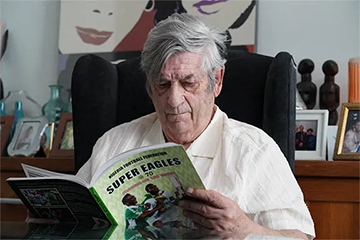
By Kunle Solaja, Nigeria’s Most Capped World Cup Journalist
As Clemens Westerhof turns 86 this Sunday, May 3, Nigerian football pauses to honour a man whose name is etched permanently into the country’s sporting identity.
Under the theme Heroes of the World Cup, Westerhof’s birthday is more than a personal milestone.
It echoes the moment Nigeria found its voice on the global stage. No coach before or after him has matched his achievements with the Super Eagles, making his legacy both historic and enduring.
The Man Who Took Nigeria to the World
When Westerhof arrived in 1989, Nigeria had never qualified for the FIFA World Cup. Within five years, he changed that narrative.
He led the Super Eagles to their debut at the 1994 FIFA World Cup, where Nigeria dazzled with confidence and tactical maturity. The campaign nearly produced an even greater milestone—Nigeria were just 90 seconds away from eliminating Italy national football team in the Round of 16 before a late comeback ended the dream in a dramatic 2-1 defeat.
Even so, that tournament announced Nigeria as a force in world football.
The Birth of a Golden Generation
Westerhof’s greatest strength was not just winning matches but building a team that would define an era.
At a time when reliance on foreign-based players was growing, he boldly trusted home-based talents, guiding a largely domestic squad to a runners-up finish at the 1990 Africa Cup of Nations.
That decision laid the foundation for what would later be known as Nigeria’s “Golden Generation.”
His record at the Africa Cup of Nations remains unmatched:
- * Runners-up (1990)
- * Third place (1992)
- * Champions (1994)
No other Nigerian coach has reached all three podium levels.

Clemens Clemens Westerhof displays a photograph of himself holding the AFCON trophy at his quiet home in Arnhem, the Netherlands
From Raw Talent to Global Recognition
Westerhof’s tenure transformed raw Nigerian talent into a cohesive, world-class unit. Under his guidance, the Super Eagles rose to fifth in the FIFA world rankings—the highest in the nation’s history. No African team has attained that ranking.
He introduced professionalism, structure, and discipline, while nurturing players who would go on to achieve global acclaim. He also brought innovations, including the adoption of official team kits, helping modernise the national team’s identity.
A Journey of Trials and Triumphs
His early days were far from smooth. His first official match, a World Cup qualifier against Cameroon in Yaoundé on August 27, 1989, ended in defeat. He had earlier witnessed from the stands Nigeria’s qualifiers against Gabon and Angola, the latter overshadowed by the tragic death of Samuel Okwaraji.
Yet from those difficult beginnings emerged one of the most successful eras in Nigerian football.
Still Watching, Still Connected at 86
Now living quietly in Arnhem, Westerhof remains deeply connected to the game. His wife, Lilian, told Sports Village Square about Westerhof’s devotion to football—particularly African competitions—as almost religious, noting his keen interest in recent tournaments like the 2023 AFCON.

Three members of Westerhof’s golden generation of Nigerian football.
Even decades after leaving Nigeria, his bond with the country and its players remains strong.
A Lasting World Cup Hero
After his Nigerian adventure, Westerhof went on to coach Zimbabwe and later Mamelodi Sundowns. But it is his time with the Super Eagles that defines his legacy.
As he marks his 86th birthday this Sunday, Westerhof stands tall among football’s great architects—a World Cup hero not for goals scored, but for dreams realised.
For Nigeria, his story is timeless: the man who turned potential into power, and belief into history.
Join the Sports Village Square channel on WhatsApp: https://whatsapp.com/channel/0029Vaz7mEIGk1FxU8YIXb0H
By Kunle Solaja
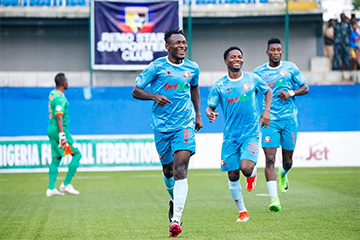
The battle to beat the drop in the Nigeria Premier Football League (NPFL) reaches a critical point this weekend as former champions Enyimba FC host Remo Stars FC in a tension-soaked Matchday 36 encounter in Aba.
With just three points separating 13th-placed Enyimba and bottom club Wikki Tourists, the relegation scrap has tightened into a nerve-racking dogfight involving as many as eight teams. Both Enyimba and Remo Stars sit precariously on 43 points, alongside Niger Tornadoes and Kwara United, making every remaining fixture decisive.
A Rivalry Tilting One Way
History offers little comfort to the hosts. In 14 NPFL meetings, Remo Stars hold the upper hand with six wins to Enyimba’s four, while four matches ended in draws.
More strikingly, Enyimba have not beaten Remo Stars in their last nine encounters spanning four years, a psychological edge that the visitors will be eager to exploit.
Sunday’s clash will also be shaped by intriguing personal subplots. Enyimba striker Edidiong Enobong Ezekiel faces his former club, determined to deny them any points in Aba. On the flip side, Remo Stars’ Victor Mboma returns to familiar territory, having previously worn the Enyimba colours with distinction.
Between them, the duo embody the shared history of both clubs, Mboma boasting 31 goals for Enyimba and 26 for Remo Stars, adding extra emotional weight to an already high-stakes encounter.
Pressure Beyond Aba
The outcome in Aba may not be enough on its own. Results elsewhere will significantly influence the relegation picture, with key fixtures including:
- * Kun Khalifat FC vs Kano Pillars
- * Warri Wolves FC vs Plateau United
With so many teams clustered on the same points tally, goal difference and head-to-head records could ultimately prove decisive.
What’s at Stake
For Enyimba, playing at home offers a vital advantage, but recent history against Remo Stars suggests no guarantees. For Remo Stars, survival may depend on securing a rare positive result on the road, a challenge they must meet head-on.
As the NPFL season approaches its climax, this clash is more than just a fixture — it is a survival test where reputations, pride, and top-flight status hang in the balance.
Position Club P W D L GF GA GD Points 12 Kano Pillars 35 14 6 15 32 36 -4 45 13 Enyimba 35 11 10 14 39 39 0 43 14 Niger Tornadoes 35 12 7 16 34 34 0 43 15 Kwara United 35 12 10 13 28 30 -3 43 16 Remo Stars 35 13 4 18 38 43 -5 43 17 Warri Wolves 35 11 10 14 33 39 -6 43 18 Kun Khalifat 35 10 10 15 35 41 -6 40 19 Bayelsa United 35 10 10 15 32 38 -6 40 20 Wikki Tourists 35 9 13 13 32 39 -7 40
Join the Sports Village Square channel on WhatsApp: https://whatsapp.com/channel/0029Vaz7mEIGk1FxU8YIXb0H
By Kunle Solaja.
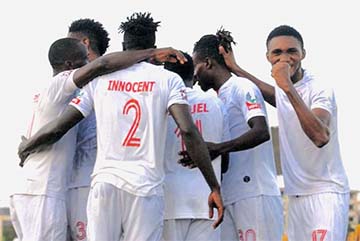
With just three rounds left in the Nigeria Premier Football League season, the battle for the title—and survival—has reached a boiling point, setting the stage for a defining weekend across the country.
At the summit, Enugu Rangers cling to top spot with 59 points, but their advantage is razor-thin. Just one point behind are Rivers United on 58, while Ikorodu City and Abia Warriors remain within striking distance on 55 points each.
Leaders Face Tricky Test in Yenagoa
Rangers’ title credentials will be tested on Sunday when they travel to face Bayelsa United, a side battling to escape relegation.
It is a classic high-stakes encounter—top versus bottom pressure. While Rangers chase glory, Bayelsa, sitting 19th, are desperate for points to avoid the drop. Anything less than a win for the leaders could open the door for their closest challengers.
Rivers United, Abia Warriors in Direct Showdown
Arguably, the headline fixture of the weekend takes place in Port Harcourt, where Rivers United host Abia Warriors.
This clash has significant implications at both ends of the title race equation. A win for Rivers United could propel them to the top—depending on Rangers’ result—while Abia Warriors, currently fourth, could leapfrog into serious contention with an away victory.
Ikorodu City Lurking, Waiting to Strike
Ikorodu City, one of the season’s surprise packages, will play on Monday against bottom-placed Wikki Tourists.
With a game in hand over their rivals, Ikorodu City have a golden opportunity to apply pressure on the leaders. A win would potentially take them level with or even above the frontrunners, depending on earlier results.
Mid-Table Battles with Continental Implications
Elsewhere, teams like Shooting Stars (5th, 54 points) and Nasarawa United (6th, 53 points) face off in a clash that could shape continental qualification hopes.
Similarly, Bendel Insurance will host Katsina United, with both sides still eyeing a late push into the top four.
Relegation Fight Intensifies
At the other end of the table, the survival battle is just as fierce. Only three points separate 13th-placed Enyimba and 20th-placed Wikki Tourists, leaving eight teams nervously looking over their shoulders.
Key fixtures include:
- * Kun Khalifat vs Kano Pillars
- * Warri Wolves vs Plateau United
- * Enyimba vs Remo Stars
Each of these matches carries enormous consequences, with a single result capable of reshaping the relegation picture.
A Season on the Edge
As the NPFL season hurtles toward its conclusion, the margins could not be tighter. Just one point separates first from second, while the gap between mid-table safety and relegation danger is almost non-existent.
This weekend’s fixtures could prove decisive—not just in determining who lifts the trophy, but also who survives the drop.
In a league defined by unpredictability, the final stretch promises drama, tension, and possibly one of the closest finishes in NPFL history.
The Full Fixtures
Sunday, May 3, 2026
- Kun Khalifat v Kano Pillars
- Rivers United v Abia Warriors
- Barau v El Kanemi Warriors
- Shooting Stars v Nasarawa United
- Bendel Insurance v Katsina United
- Bayelsa United v Enugu Rangers
- Enyimba v Remo Stars
- Warri Wolves v Plateau United
Monday, May 4, 2026
Ikorodu City v Wikki Tourists
Join the Sports Village Square channel on WhatsApp: https://whatsapp.com/channel/0029Vaz7mEIGk1FxU8YIXb0H


Ten World Cups, One Platform: Brands Invited to Ride with Sports Village Square

Portuguese Brains, African Glory: Cardoso and Santos Set for Tactical Duel in CAF Final

Escape route opens for Tottenham, but De Zerbi says more to do
Breaking! Uzoho suspended from Super Eagles’ next match with Sierra Leone
No longer Super League as CAF changes name of its new clubs competition
NIGERIAN FOOTBALL CHIEF EXECUTIVE, SANUSI CHARGES NIGERIAN COACHES TO BE UPRIGHT, DILIGENT
-

 Boxing2 days ago
Usyk backs Joshua to beat Fury ahead of heavyweight showdown
-

 Nigerian Football1 week ago
Kunle Soname at 60: The Quiet Architect of Nigerian Football’s Modern Dream
-

 Olympics5 days ago
Super Falcons Draw Bye, Set to Face South Sudan or Comoros in LA 2028 Olympic Qualifiers
-

 Boxing7 days ago
Joshua to make comeback fight in Riyadh in July before facing Fury
-

 World Cup4 days ago
Iranian Football Delegation Turned Back at Toronto Airport, Miss FIFA Congress
-

 Governing Bodies5 days ago
CAF, UEFA Renew Alliance 29 Years After Meridian Cup Pact
-

 Nigerian Football1 week ago
African Football in Mourning as Motsepe Pays Tribute to Eneramo
-

 U-20 FOOTBALL6 days ago
Football Meets History as Ghana Set To Celebrate 70 Years of Independence with U-20 Afcon Hosting