Nigerian Football
Dalung Condoles NFF Over Hamilton

Nigeria’s sports minister, Solomon Dalung, has expressed deep shock and sincere sympathy to the Nigeria Football Federation, friends and family members over the death of former Super Eagles Coach, Paul Hamilton.
In a press release signed by Nneka Ikem Anibeze, the special assistant on media, Dalung remarked that the coach’s death came at a time his experience was needed to develop other football coaches in the country as government continues its grassroots development agenda in sports.
“I was shocked when I heard the news. His service to fatherland and achievements in the football world was inspiring. We could have counted on Hamilton to impart in younger coaches with his wealth of knowledge.
My prayers are with the members of his immediate family, close associates and all football loving Nigerians.”
Dalung described the 75-year-old ex-international popularly known as ‘Wonder Boy’ as a true professional and a nationalist who sacrificed his entire life for Nigeria through sports.
“Looking at his rich CV and his commitment to his duties at the time when football was not as lucrative as it is now, it was obvious that all he did was because of his love for his fatherland,” Dalung said.
Hamilton died at the Lagos University Teaching Hospital, Idi Araba on Thursday.

By Kunle Solaja
More than a century after football first took root on Nigerian soil, the game is, in many ways, returning to its spiritual home.
Legend holds that Nigeria’s earliest recorded football match took place in Calabar on June 15, 1904, when students of Hope Waddell Training Institution faced British sailors from HMS Thistle.
While historians continue to debate the accuracy of that account, there is far less dispute about where the sport truly found its structure, identity and national relevance. This is Lagos!
From its colonial beginnings to the modern professional era, Lagos has remained the nerve centre of Nigerian football.
It was here that the game’s organisation first took shape with the establishment in 1932 of the Lagos & District Amateur Football Association (LDAFA), now known as the Lagos State Football Association — the oldest football body in the country.
It was also in Lagos that football evolved into a national movement. In 1933, the Nigeria Football Association (NFA), today’s Nigeria Football Federation (NFF), was founded in the city, laying the administrative foundation for the sport across the country, despite lingering misconceptions that place its origin in 1945.
The city’s football heritage is equally tied to infrastructure. In 1936, Lagos witnessed the construction of Nigeria’s first major football arena, the Association Ground.
Over the decades, the facility has undergone several transformations — from King George V (KGV) Stadium to Lagos City Stadium, Onikan Stadium, and now the Mobolaji Johnson Arena — remaining a symbolic heartbeat of the game. The structures may have changed, but the ground at the waterfront remains the same.

Nigeria’s oldest football ground, the waterfront Mobolaji Johnson Arena, is set to host more Nigeria Premier Football League matches than any other venue in the 2026/27 season.
Today, that heartbeat is growing stronger.
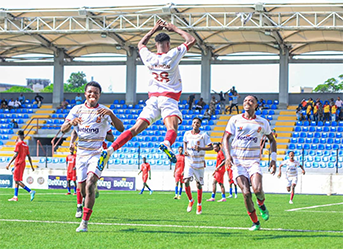
With the promotion of Sporting Lagos and Inter Lagos to the Nigeria Premier Football League (NPFL), alongside Ikorodu City, Lagos now boasts three clubs in the country’s top flight — a development that signals a return to an era when the city dominated the domestic game.


The Lagos trio of Inter Lagos, Ikorodu City and Sporting Lagos will make Lagos the hub of the NPFL
The resurgence echoes the early 1990s, particularly 1993, when Lagos was home to four of the 16 clubs in the professional league — including the iconic Stationery Stores, Julius Berger, ACB, and VIP. During that period, the city was widely regarded as the epicentre of Nigerian football culture, talent and competition.
Three decades later, history appears to be repeating itself — albeit with a modern twist.
Unlike the largely corporate-backed teams of the past, the current Lagos trio is privately owned, reflecting a shift in the structure of Nigerian football. Analysts see this as a positive development, suggesting that private investment could bring improved management, financial stability and long-term vision to the domestic league.
Beyond symbolism, the practical benefits are significant. With three Lagos-based teams in the NPFL, each club is expected to play at least 12 of its 36 league matches within the city, reducing travel costs and logistical strain.
The proximity of neighbouring clubs such as Shooting Stars in Ibadan and Remo Stars in Ikenne further strengthens the regional football ecosystem, offering opportunities for local rivalries and increased fan engagement.
For Lagos, the implications go beyond numbers. The return of multiple top-flight clubs reinforces its status not just as a historical cradle of Nigerian football, but as a present-day engine for its growth.
As the new NPFL season approaches, one narrative stands out: football, in many ways, is coming back home — to Lagos, where its story in Nigeria was first truly written.
Join the Sports Village Square channel on WhatsApp: https://whatsapp.com/channel/0029Vaz7mEIGk1FxU8YIXb0H
By Kunle Solaja.
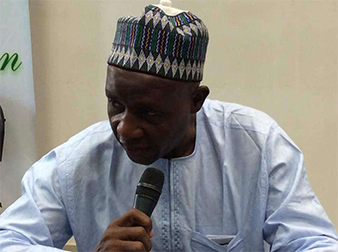
The death of Ibrahim Galadima on Saturday has not only drawn tributes from across the Nigerian football community, but it has also quietly marked the further thinning of a generation that once steered the country’s football fortunes.
Galadima, who presided over the Nigeria Football Association (NFA)—now known as the Nigeria Football Federation (NFF)—between 2002 and 2006, joins a growing list of former helmsmen whose voices have faded into history.
Since its founding in August 1933, Nigeria’s football governing body has had 34 presidents and chairmen, each leaving their imprint, whether through reform, controversy, or moments of national glory.
Today, however, only seven of those former leaders remain alive. This is a stark reminder of the passage of time and the changing face of football administration in Nigeria.
The surviving former heads are:
- Amaju Pinnick
- Aminu Maigari
- Sani Lulu Abdullahi
- Anthony Kojo Williams
- Amos Adamu
- Abdulmumini Aminu
- Yusuf Ali
A Roll Call of Departed Administrators
In recent years, the Nigerian football family has witnessed the steady departure of several of its former leaders:


- Dominic Oneya (d. August 2021)
- John Obakpolor (d. February 1, 2021)
- Emeka Omeruah (d. December 4, 2006)
- Earlier, the nation had bid farewell to notable figures such as:
- Efiom Edem Okon, who passed away on January 1, 2013, in Chelmsford, Essex, at the age of 88
- Chuba Ikpeazu, who died on December 27, 2004, aged 92
Remembering Okwechime and Dankaro’s Era
One of the defining administrators of the early 1980s, Mike Okwechime, died on February 23, 2018, in Benin City at the age of 87.

Col. Mike Okwechime, NFA Chairman, 1981-1982
Okwechime’s tenure was brief but significant. He took over the leadership of the NFA in 1981 from Sunday Dankaro, who had presided over Nigerian football from 1974 to 1980—a period remembered for structural consolidation within the game.
Before his appointment, Okwechime had served as a colonel heading the then National Sports Council, underscoring the long-standing intersection between military administration and sports governance in Nigeria.
The passing of Galadima is more than the loss of a former football administrator; it is part of a broader transition. These were men who governed Nigerian football in eras defined by limited resources, political interference, and evolving international expectations.
Their tenures spanned military regimes, democratic transitions, and the globalisation of football administration.
As their numbers dwindle, so too does a direct link to the institutional memory of Nigerian football—from its colonial roots in 1933 to its modern-day complexities.
A Moment for Reflection
With only seven former heads of the federation still alive, Nigerian football stands at a reflective crossroads.
The question now is not just about remembering these administrators, but about preserving their experiences, both the triumphs and the missteps, as guiding lessons for future leadership.
For in their stories lies the unfinished narrative of Nigerian football itself.
Join the Sports Village Square channel on WhatsApp: https://whatsapp.com/channel/0029Vaz7mEIGk1FxU8YIXb0H
By Kunle Solaja.
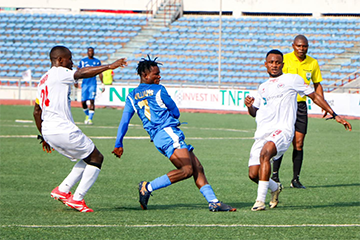
Nigeria Premier Football League (NPFL) title race took another dramatic turn on Matchday 35 as leaders Enugu Rangers strengthened their grip at the summit, while challengers Rivers United stumbled to keep the contest wide open with three matches to go.
Rangers moved to 59 points after a hard-fought 2-1 victory over Enyimba in Enugu on Sunday, extending their lead at the top. The Flying Antelopes showed resilience against their Oriental rivals, reinforcing their title credentials at a crucial stage of the season.
However, the biggest twist of the weekend came in Kano, where Kano Pillars defeated Rivers United 2-1, halting the Port Harcourt side’s momentum. The result leaves Rivers United just one point behind the leaders on 58 points, setting up a tense run-in.
Top Four Battle Intensifies
The race for continental spots is equally fierce, with Ikorodu City and Abia Warriors locked on 55 points.
Abia Warriors boosted their chances with a 2-1 win over Ikorodu City, a result that not only tightened the top four race but also dealt a blow to Ikorodu’s ambitions of closing the gap on the top two.
Shooting Stars, sitting fifth on 54 points, also kept pace with a valuable 2-1 away win against El Kanemi, staying firmly in contention for a continental ticket.
Mid-Table Shuffle
Further down the table, Nasarawa United delivered one of the most emphatic performances of the round, thrashing Warri Wolves 3-0 to climb to sixth with 53 points.
Bendel Insurance, who edged Wikki Tourists 2-1 on Saturday, remain seventh with 52 points, continuing their quiet push toward the top tier.
Elsewhere:
- Katsina United edged Bayelsa United 3-2 in a five-goal thriller
- Kwara United defeated Barau FC 2-1
- Remo Stars boosted survival hopes with a commanding 3-0 win over Niger Tornadoes
- Plateau United and Kun Khalifat settled for a 1-1 draw

Relegation Fight Goes Down to the Wire
At the bottom, the battle to avoid relegation remains intense. Wikki Tourists, Bayelsa United, and Kun Khalifat are all tied on 40 points, with only goal difference separating them.
Despite their defeat, Wikki Tourists remain within reach of safety, while Bayelsa United’s narrow loss in Katsina further complicates their survival hopes.
A Nervy Finish Beckons
With just three rounds left, the NPFL season is heading for a thrilling conclusion.
Rangers hold a slender advantage, but Rivers United remain firmly in pursuit, while the chasing pack continues to apply pressure from behind.
At both ends of the table, nothing is settled—ensuring that the final weeks of the season will be defined by tension, drama, and possibly, late twists in Nigeria’s top-flight story.
Week 35 Results
Saturday April 18
- Wikki Tourists 1-2 Bendel Insurance
Sunday April 19
- Plateau United 1-1 Kun Khalifat
- Enugu Rangers 2-1 Enyimba
- Katsina United 3-2 Bayelsa United
- Kano Pillars 2-1 Rivers United
- Kwara United 2-1 Barau
- Abia Warriors 2-1 Ikorodu City
- El Kanemi 1-2 Shooting Stars
- Nasarawa United 3-0 Warri Wolves
- Remo Stars 3-0 Niger Tornadoes
The Table
Pos Club P W D L F A GD Pts 1 Enugu Rangers 35 16 11 8 41 25 16 59 2 Rivers United 35 16 10 9 35 29 6 58 3 Ikorodu City 35 15 10 10 38 32 6 55 4 Abia Warriors 35 16 7 12 30 27 3 55 5 Shooting Stars 35 16 6 13 37 37 0 54 6 Nasarawa United 35 15 8 12 34 28 6 53 7 Bendel Insurance 35 13 13 9 41 35 6 52 8 Katsina United 35 13 10 12 32 34 -2 49 9 Plateau United 35 14 5 16 38 38 0 47 10 Barau FC 35 11 13 11 28 29 -1 46 11 El Kanemi 35 13 7 15 30 40 -10 46 12 Kano Pillars 35 14 6 15 32 36 -4 45 13 Enyimba 35 11 10 14 39 39 0 43 14 Niger Tornadoes 35 12 7 16 34 34 0 43 15 Kwara United 35 12 10 13 28 30 -3 43 16 Remo Stars 35 13 4 18 38 43 -5 43 17 Warri Wolves 35 11 10 14 33 39 -6 43 18 Kun Khalifat 35 10 10 15 35 41 -6 40 19 Bayelsa United 35 10 10 15 32 38 -6 40 20 Wikki Tourists 35 9 13 13 32 39 -7 40
Join the Sports Village Square channel on WhatsApp: https://whatsapp.com/channel/0029Vaz7mEIGk1FxU8YIXb0H


USM Alger Edge Olympique Safi to Reach Confederation Cup Final After Chaotic Semi-Final

Football Returns Home: Lagos Reclaims Its Place at the Heart of the Nigerian Game

End of an Era: Galadima’s Passing Shrinks Rank of Nigeria’s Football Leaders
Breaking! Uzoho suspended from Super Eagles’ next match with Sierra Leone
No longer Super League as CAF changes name of its new clubs competition
NIGERIAN FOOTBALL CHIEF EXECUTIVE, SANUSI CHARGES NIGERIAN COACHES TO BE UPRIGHT, DILIGENT
-

 UEFA Champions League7 days ago
Heineken Ramps Up Champions League Activations as Quarter-Final Drama Peaks
-

 Premier League7 days ago
Ghana player Partey pleads not guilty to additional rape charges in UK
-

 Nigerian Football1 week ago
Title Race Goes Down to the Wire as Relegation Battle Intensifies in NPFL
-

 Premier League6 days ago
Nigerian-Descent Okafor Hits Brace to Sink Manchester United at Old Trafford
-

 OBITUARY7 days ago
Ghana Police Detail How Berekum Chelsea Player Was Killed in Armed Robbery Attack
-

 World Cup5 days ago
FIFA Weighs Request to Trump Over ICE Raids During 2026 World Cup
-

 MEDIA5 days ago
Former SWAN Chief, Ndubuoke, Charges Nigerian Sportswriters to Uphold Ethics Amid Rising Corruption
-

 Boxing1 week ago
Fury Calls Out Joshua After Dominant Win Over Makhmudov