
Nigerian Football
Rivers Hope To Win Without Eguma

BY SAMMY WEJINYA.
This is the most trying period in the history of Rivers United FC. Technical manager, Stanley Eguma, is currently serving a one-match suspension while results on the pitch have been far from positive.
The ‘Pride of Rivers’ have yet to win in their last four games in all competitions and the alarm bells are well and truly ringing.
On Sunday, stars of the Port Harcourt club will attempt to hit positive notes when they file out against Gombe United at the Pantami Stadium, Gombe as the Nigeria Professional Football League (NPFL) enters match day 17.
Draws away from home are usually celebrated in the NPFL but the boys from Port Harcourt know that a point on Sunday may not be enough to assuage the smitten emotions of the teeming faithful.
Head coach of Rivers United, Willy Udube, knows this well and acknowledges that while a win in Gombe would be extremely difficult, it is a possibility his charges will be looking to exploit.
“The technical manager (Eguma) was given a one-match suspension but we have been able to steady (the ship) by making the players understand that (such things) can always happen in football.
“It has happened and we have to move on. We want to get all three points (against Gombe United) but football is not mathematics.
“I strongly believe that we will go home with something to make our fans happy.
“As I am talking to you now, the spirit is very very high,” Udube told the club’s official website, www.riversunitedfc.com.ng.
Saying the right things before big games is almost a pre-requisite for trainers but beating Gombe United at the Pantami is easier said than done.
There are no star turns at Gombe United as experienced tactician, Manu Garba, the club’s technical supremo is known to prefer graft over the spectacular.
Alhassan Yusuf, Maurice Chigozie, Akeem Balogun, Isaac Giwa, Bilya Yarma, Idris Bakare, Mannir Ubale and Sadiq Shuaibu are not names that easily roll off the tongue but wily gaffer, Garba has integrated these unheralded talent into an almost impregnable and extremely-cohesive unit.
Garba’s assistant, Hassan Abubakar is ultra-confident in his side’s chances of securing maximum points against last season’s NPFL runners up.
“I know we will win on Sunday because we have prepared very well for this game against Rivers United.
“They may not be doing too well this season but they are a good team with very good players.
“We drew our last game away from home against ABS FC so confidence is very high amongst our players,” he said.
The newly-promoted Gombe United will be keen to avoid any slip ups to prevent the drama of a relegation dogfight in the coming days while Rivers United know that defeat is almost non-negotiable.
A compelling and intriguing contest awaits on Sunday.

By Kunle Solaja, Ikenne
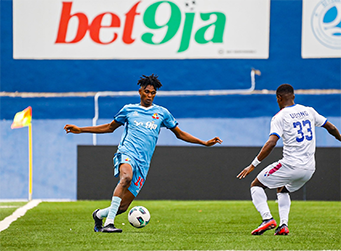
Former champions Bayelsa United and Wikki Tourists have been relegated from the Nigeria Premier Football League (NPFL) after dramatic Matchday 37 defeats left the title race and survival battle heading into a tense final day on May 24.
At the Remo Stars Stadium in Ikenne, Bayelsa United suffered a 2-1 defeat to Remo Stars despite taking an early lead through Ofem Nneoyi in the seventh minute. The striker raced through on goal before calmly finishing past goalkeeper Adebiyi Obassa.
Remo Stars responded before the break when Alex Oyowah rose highest to head home the equaliser five minutes before halftime. Veteran forward Victor Mbaoma then struck the decisive goal in the 64th minute to hand the hosts a crucial victory that preserved their hopes of top-flight survival.
In Bauchi, Wikki Tourists twice led against Rivers United but eventually crashed 3-2 at the Abubakar Tafawa Balewa Stadium in a pulsating encounter that also kept the title race alive until the final day.
Jonathan Mairiga gave Wikki the lead in the 21st minute before Handsome Surveyor restored parity for Rivers United in the 34th minute. Imamu Bala put Wikki ahead again four minutes into the second half, but Chijioke Mbaoma levelled for the visitors before Taofeek Otaniyi netted the dramatic winner in the 85th minute.
Rivers United’s late winner proved decisive for the championship race. For much of the afternoon, the Rangers looked set to clinch the title after establishing what had become a four-point lead while Rivers were trailing in Bauchi.
However, Rivers United’s comeback reduced Rangers’ advantage to just one point, ensuring the battle for the NPFL crown will be settled on the final day of the season.
Rangers, the only NPFL club never to have suffered relegation, edged Bendel Insurance 2-1 in Enugu to stay top of the table on 65 points. Godwin Obaje scored twice for the Flying Antelopes, while Alex Oweilayefa grabbed Bendel Insurance’s goal.
Rivers United remain second on 64 points and will host Katsina United on the final day, while Rangers travel to Lagos for a difficult encounter against Ikorodu City.
The race for continental qualification also intensified after Shooting Stars defeated Barau FC 1-0 in Ibadan courtesy of Lucky Emmanuel’s first-half strike. The Oluyole Warriors climbed to third place with 60 points.
Ikorodu City, however, suffered a heavy 4-1 defeat away to Katsina United. Jamilu Yusuf scored twice for the hosts, while Azeez Falolu and Daniel Agara added further goals. Abayomi Ayodeji scored Ikorodu City’s lone goal.
Kano Pillars boosted their survival hopes with a narrow 1-0 win over Warri Wolves thanks to a Rabiu Ali penalty, while Federation Cup holders Kwara United defeated Enyimba 2-0 through Bright Babatunde’s first-half brace.
In Lafia, Nasarawa United beat Plateau United 1-0 with Jofrank Istifanus scoring the only goal, though the result was not enough to keep them in contention for a continental ticket.
Perhaps the biggest surprise of the round came in Aba, where Kun Khalifat stunned Abia Warriors 2-0. Uchechukwu Onuoha scored both goals to move the newcomers closer to securing another season in the NPFL.
El-Kanemi Warriors and Niger Tornadoes played out a goalless draw in Maiduguri.
With one round of matches remaining, Rangers lead the standings on 65 points, one ahead of Rivers United, while Bayelsa United and Wikki Tourists are confirmed as the two relegated sides
Join the Sports Village Square channel on WhatsApp: https://whatsapp.com/channel/0029Vaz7mEIGk1FxU8YIXb0H
Nigerian Football
Ever-Present Falconets Qualify for 2026 FIFA U20 Women’s World Cup Despite Malawi Scare
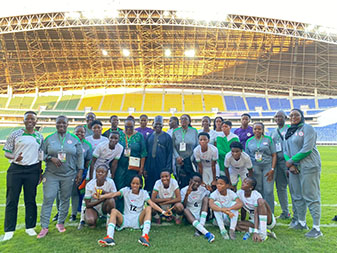
Nigeria’s U20 girls, the Falconets, once again underlined their status as Africa’s most consistent side at youth level after sealing qualification for the 2026 FIFA U20 Women’s World Cup in Poland despite a nervy 2-1 defeat to Malawi’s Young Scorchers in Lilongwe on Saturday.
The seven-time African champions progressed 3-2 on aggregate, relying on the crucial 2-0 first-leg victory secured in Ikenne a week earlier through an own goal by Malawi defender Maureen Kenneth and a fine strike from Kindness Ifeanyi.
The qualification means Nigeria have maintained their remarkable record of appearing at every edition of the FIFA U20 Women’s World Cup since the competition was introduced.
Backed by a passionate home crowd in Lilongwe, the Young Scorchers came out aggressively and quickly put the Falconets under pressure. Their persistence paid off early in the first half when a defensive mix-up in the Nigerian backline allowed a Malawian attacker to head home the opener and spark hopes of an unlikely comeback.
Nigeria almost responded immediately through the lively Kindness Ifeanyi, whose dangerous delivery from the right flank found Favour Nkwocha inside the area. However, Nkwocha’s powerful effort crashed against the woodwork as the hosts carried a 1-0 lead into halftime.
The tension intensified 10 minutes after the restart when another lapse in Nigeria’s defence gifted Malawi a second goal, drawing the tie level at 2-2 on aggregate and placing the Falconets’ proud qualification streak in serious danger.
With the momentum shifting towards the hosts, Falconets coach Moses Aduku turned to his bench for inspiration, and substitute Precious Oscar delivered at the decisive moment.
Oscar capitalised on hesitation in the Malawian defence in the 62nd minute, dispossessing an opponent before calmly slotting past the goalkeeper to hand Nigeria a priceless away goal and restore their aggregate advantage.
The strike silenced the home crowd and ultimately proved decisive as the Falconets showed composure and resilience in the closing stages to protect their lead and confirm another appearance on the global stage.
Although the defeat marked a rare away setback for Aduku’s side after impressive victories in Rwanda and Senegal earlier in the qualifying campaign, the Falconets achieved their primary mission of securing qualification for the world finals.
The 2026 FIFA U20 Women’s World Cup will be held in Poland from September 5 to 26.
Following the match, the Nigerian delegation expressed appreciation to Nigeria’s High Commissioner to Malawi, Ambassador Ibrahim Miringa, and the staff of the Nigerian mission in Malawi for their hospitality and support throughout the team’s stay in the southern African nation.
Join the Sports Village Square channel on WhatsApp: https://whatsapp.com/channel/0029Vaz7mEIGk1FxU8YIXb0H
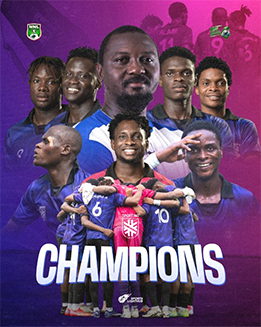
Sporting Lagos have emerged champions of the 2026 Nigeria National League (NNL) after edging city rivals Inter Lagos on goal difference at the end of the season-ending Super Four tournament in Ikenne, Ogun State.
The competition concluded on Friday at the Remo Stars Stadium with a dramatic Lagos derby that saw Inter Lagos defeat Sporting Lagos 1-0 on the final day.
Despite the loss, the “Tech Boys” still claimed the NNL title and the accompanying ₦10 million prize money after finishing top of the standings on superior goal difference.
Sporting Lagos entered the decisive Matchday Three needing only a draw to secure the crown, but their commanding earlier performances proved decisive. They had opened the Super Four campaign with a 1-0 victory over Ranchers Bees before producing the tournament’s most emphatic result with a 4-0 demolition of Doma United.
Inter Lagos also finished the competition on six points after recovering from an opening 1-0 defeat to Doma United. They responded with a 1-0 win over Ranchers Bees before securing the derby triumph against Sporting Lagos.
Ranchers Bees and Doma United finished third and fourth respectively, completing the quartet of clubs that have secured promotion to the 2026/27 Nigeria Premier Football League season.
For Sporting Lagos, the Super Four triumph represents a strong statement ahead of their return to top-flight football, while Inter Lagos will also head into the elite division with confidence after an impressive finish to the tournament.
The final day of the competition provided an entertaining atmosphere at the Remo Stars Stadium, with the well-organised event offering a glimpse of what fans can expect from the newly promoted clubs in the coming NPFL campaign.
Join the Sports Village Square channel on WhatsApp: https://whatsapp.com/channel/0029Vaz7mEIGk1FxU8YIXb0H


Arsenal survive huge scare to edge towards title

Lagos Set for Global Table Tennis Showdown as WTT Contender Returns

Rangers, Rivers Set for Final-Day NPFL Title Shootout as Bayelsa, Wikki Go Down
Breaking! Uzoho suspended from Super Eagles’ next match with Sierra Leone
No longer Super League as CAF changes name of its new clubs competition
NIGERIAN FOOTBALL CHIEF EXECUTIVE, SANUSI CHARGES NIGERIAN COACHES TO BE UPRIGHT, DILIGENT
-

 Boxing1 week ago
Usyk backs Joshua to beat Fury ahead of heavyweight showdown
-

 World Cup3 days ago
FIFA Plans Three Opening Ceremonies in All Host Nations for 2026 World Cup
-

 World Cup2 days ago
Mexico president wavers on plan to cut school year by 40 days for the World Cup
-

 World Cup3 days ago
Burna Boy Joins Shakira for Official 2026 World Cup Song ‘Dai Dai’
-

 World Cup2 days ago
United States Unveils Hollywood-Style FIFA World Cup 2026 Opening Ceremony
-

 World Cup1 week ago
‘They are not representing Iran’: protesters urge FIFA to ban Iran from World Cup
-

 World Cup6 days ago
Despite 2026 Absence, Nigeria Still Leads Africa’s World Cup Winners’ Chart
-

 Nigerian Football3 days ago
Sporting Lagos Crowned 2026 NNL Champions After Dramatic Super Four Finale